Animal welfare
Royal A-ware recognises the importance of animal welfare and is committed to ensuring high standards across its value chain. Cows are central to our products, and we collaborate with our dairy farmers to ensure continuous attention and improvement of animal health and welfare. Additionally, we recognise the growing interest from society and stakeholders, including customers and NGOs, in understanding how dairy cows are kept, and we aim to be transparent about our practices and standards.
Impacts, risks and opportunities
As part of our DMA, we identified the following material risks and opportunity related to 'Animal welfare and health':
Risk
Risk of reputational damage for Royal A-ware and/or the entire dairy sector as a result of failure to ensure animal welfare and health.
Opportunity
Opportunity to develop and offer different milk streams beyond legal requirements to animal health and welfare.
Our approach
As part of its commitment to ensuring high standards across its value chain, Royal A-ware has an animal welfare and health policy. We use the Five Domains Model as a guideline for defining animal welfare. According to this model, animals’ mental states are directly influenced by their health, environment, nutrition and behaviour.
To assess the mental state of a cow we use the European Welfare Quality Protocol as a base. This protocol is developed by European Welfare specialist (based on amongst others scientific evidence) to gain insight in animal welfare on farms via a standardised method.
Royal A-ware utilises equivalent tools for measuring cow welfare, including the Cow Compass (KoeKompas), Periodic Farm Visit Plus (Periodiek Bedrijfsbezoek Plus; PBB+) and the Cattle Check-up, which is based on PBB+.
Continuous improvement
We use the Plan Do Check Act (PDCA) cycle to monitor and continuously adjust the action plan to ensure the objectives are met. Every year we evaluate whether we are on track and identify any new insights that should be included in the action plan.
The proposals are discussed with the focus group of dairy farmers. Royal A-ware has two focus groups, one in Belgium and one in the Netherlands. Feedback from these panels is very valuable to ensure that adjustments are practical and provide added value. After this evaluation, the managers Farmer Support in the Netherlands and Belgium will determine any actions.
In the Netherlands and Germany, the COO is responsible for the policy and target, while the Manager Dairy Affairs is responsible in Belgium. The policy and accompanying targets apply to all dairy farmers with whom Royal A-ware has a cooperation agreement and who have supplied milk to the Dutch and Belgian legal entities.
Objectives and actions
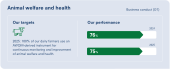
Our goal in 2025 is for 100% of the dairy farmers with whom we work directly to use one of the tools derived from the Welfare Quality assessment. Annually, we evaluate the results of these measures to adjust them if necessary or introduce new actions. Currently our focus is to make sure all farmers use the instruments as a minimum. In the future next steps can be considered.
To achieve our goal, we implement ongoing actions such as:
-
Ensuring dairy farmers in the Netherlands meet the Cow Compass or PBB+ requirement. If a farmer fails to meet this requirement, Royal A-ware can ultimately decide to suspend milk collection until the farmer achieves this requirement.
-
Incentivising the Cattle Check-Up in Belgium through our A-ware Duurzaam programme.
-
Mandating the Cow Compass tool in the milk streams Beter voor, KoeBewust and Boerderijmelk.
-
Mandating PBB+ for German farmers. Since this is an above legislation obligation, working with PBB+ is also incentivised via our A-ware Duurzaam programme.
-
Organising activities such as workshops and webinars on animal welfare and health in Belgium, Germany and the Netherlands.
Targets and achievements
In 2025 our percentage dropped minimal to 75% from 76% in 2024. The main explanation for this drop is the increasing number of dairy farmers in Belgium that only recently joined our company in 2025. In 2026 we will undertake action to increase the percentage over the year 2026.