
Biodiversity & dairy farming
Royal A-ware recognises that biodiversity is essential for sustainable food production, supporting the ecosystems and resources that dairy farming depends on. Natural resources, such as the grass consumed by cows, rely on healthy, resilient soils. Greater biodiversity improves soil quality, leading to more nutritious and abundant feed for cows. Additionally, natural ecosystems provide essential services, such as carbon sequestration and climate regulation. We are committed to preserving and restoring ecosystems on and around dairy farms to strengthen biodiversity.
Impacts, risks and opportunities
As part of our DMA, we identified the following material impacts and opportunity related to Biodiversity:
Impacts
-
Actual negative impact on ecosystem services due to greenhouse gas emissions (GHG) associated with milk production on farms.
-
Actual negative impact on ecosystem services associated with land use for raw milk production.
-
Actual positive impact on ecosystem services as a result of the application of sustainable agricultural practices on the farm (e.g., via our milk streams and biodiversity bundles).
There are no material negative impacts related to land degradation, desertification or soil sealing or threatened species.
Opportunity
Opportunity to develop and offer different and multiple milk streams with additional legal requirements regarding biodiversity.
Our approach
Royal A-ware assessed its impact on biodiversity, covering both dairy farms and production locations. We reviewed whether production and office locations of the dairy operations are situated in Natura 2000 sites, protected areas across the European Union designed to safeguard Europe’s most valuable species and habitats. We concluded that our own operations do not have a significant impact on biodiversity in these areas.
Royal A-ware has carried out a resilience analysis to assess the resilience of the current business model and strategy on the short (<1 year), term (1-3 year) and long term (>5 year). During this analysis transition, physical and systematic risks where evaluated, we consulted various stakeholders. For more information on stakeholder involvement, please refer to the Stakeholder views and interests section of the General disclosures chapter. Our analysis concluded that there are no risks to the resilience of Royal A-ware from biodiversity and ecosystem-related factors. Therefore, no adaptations were deemed necessary.
Information on the Royal A-ware’s due diligence process for identifying, assessing and managing sustainability-related IROs, including those related to biodiversity and ecosystems in our value chain, is provided in the due diligence section of the general disclosures chapter.
Biodiversity policy
Based on our DMA and as part of our commitment to preserving and restoring ecosystems on and around dairy farms, we have developed a biodiversity policy for our dairy activities. Royal A-ware’s biodiversity policy aims to support nature-inclusive farming practices and contribute to the EU Biodiversity Strategy. The policy and target are set by the managers farmers support (in Dutch afdeling Veehouderijzaken) in the Netherlands and Belgium. The target is ultimately established by the Sustainability Steering Committee. Additionally, they apply to all dairy farmers in the value chain with whom we have a cooperation agreement within Germany, the Netherlands and Belgium. Together with our dairy farmers, we work to preserve and restore biodiversity through our biodiversity bundles.
Biodiversity bundles are the cornerstone of our policy. These bundles were developed together with the agency De Natuurverdubbelaars. These bundles consist of concrete, scientifically supported measures that, in combination, aim to conserve and restore biodiversity. The approach is based on pressure factors identified by the Louis Bolk Institute: factors related to dairy production that are responsible for biodiversity decline.
In the Netherlands, we have five biodiversity bundles including Landscape Elements, Soil Biodiversity, Biodiverse Farmyard, Biodiverse Grassland and Farmland Birds. These Dutch bundles were adapted for the Belgian context, resulting in four bundles used in Belgium. In 2025, we applied the same methodology to develop four bundles for our German dairy farmers, ensuring consistency in our biodiversity strategy across all operating countries.
Objectives and actions
Royal A-ware’s aims to preserve and restore ecosystems in and around farms to enhance biodiversity. To achieve this, we implement the following ongoing actions:
-
Incentivising our dairy farmers to adopt sustainable agricultural practices through our A-ware Duurzaam programme. Dairy farmers receive points within A-ware Duurzaam if they comply with one or more biodiversity bundles. The more points they achieve, the higher the sustainability premium the dairy farmer receives.
-
Developing the Beter voor Natuur & Boer milk stream in collaboration with Albert Heijn. As part of this programme, dairy farmers reduce land cultivation to enhance carbon sequestration. Additionally, nature-based solutions are integrated into the Beter voor Natuur & Boer milk stream requirements. For dairy farmers who make additional efforts, such as sowing herbs or refraining from ploughing grassland, Albert Heijn pays them a premium on top of the standard pasture milk price.
Actions in 2025
In 2025, we carried out the following actions:
-
Developed a biodiversity transition plan.
-
Developed biodiversity bundles for our dairy farmers in Germany.
-
Integrated the biodiversity bundles in the German edition of A-ware Duurzaam.
-
Highlighted biodiversity bundles as a key topic during the biannual farmers’ meetings.
Planned actions 2026
We plan to develop a version of the biodiversity bundles for Spain in the coming year.
Targets and achievements
The target, set in 2024 by Royal A-ware is based on expert judgment from the COO and managers of livestock affairs in Belgium and the Netherlands. It is grounded in our biodiversity bundles, which allow for potential additional measures within specific milk streams. The target does not align with the Kunming-Montréal Global Biodiversity Framework. While stakeholders were involved in the development of the biodiversity bundles, they were not involved in target setting. The measures with biodiversity bundles fall within the minimising and restoring layers of the mitigation hierarchy and has remained unchanged since its establishment.
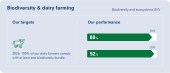
In 2024 88% of our farmers complied with the target. In 2025 this percentage has increased to 92%. Our approach on biodiversity shows clear commitment from our dairy farmers.
