
Circularity
Royal A-ware is actively integrating circular practices into its operations. We consider it our responsibility to minimise the environmental impact of our business activities, including the depletion of raw materials, the negative impacts associated with sourcing of raw materials (e.g., deforestation) and the emissions generated during waste processing. Our circularity efforts focus primarily on reducing food waste and packaging (refer to paragraph on packaging). By valorising residual streams, we not only minimise waste but also create new revenue opportunities.
'We focus on reducing food waste and packaging.'
Impacts, risks and opportunities
As part of our DMA, we identified the following material impact, risk and opportunity:
Impact
Actual negative impact on people and the environment due to the use of natural resources, which can contribute to the depletion of raw materials, deforestation and increased greenhouse gas emissions.
Risk
Risk of reputational damage and losing customers due to not sourcing high-risk raw materials sustainably, as stipulated in iMVO-covenant and EUDR.
Opportunity
Opportunity for additional revenue by maximising the use of raw materials and preventing waste through Royal A-ware valorisation approach (converting side streams into, for example, smoked and processed cheese and grated cheese).
Our approach
Risks associated with the use of high‑risk materials are mitigated through our responsible sourcing strategy, under which such raw materials must originate from Europe and/or be sourced with appropriate certification or equivalent measures. The impact and the opportunity are managed through Royal A-ware’s circularity policy which is based on the following three principles on the use of raw materials and preventing and reducing waste:
1. Prevent
-
Use raw materials efficiently by achieving high process efficiency and minimising process waste.
-
Prevent waste by repurposing whey and other side streams as food for humans.
2. Reduce
-
Reduce the use of raw materials by adjusting product recipes.
-
Reduce waste by valorising side streams as animal feed.
3. Choose more sustainable resources and materials
-
Properly separate side streams, allowing a larger proportion of side streams to be upcycled into food for humans (prevent) or animals (reduce).
-
Reprocess side streams into food for humans or animals, so that less virgin cheese and milk are needed. This contributes to the sustainable use of raw materials.
Our policy clearly distinguishes between waste, which is any material that we intend or are required to discard, and side streams, which can be repurposed in food and animal feed. The remaining organic waste that cannot be used for human or animal consumption is considered waste.
Analysis of material inflows and outflows
As part of our ESRS E5 assessment, we conducted an analysis of our material inflows and outflows to understand how resources move throughout our operations. We concluded that the substantive material inflows are:
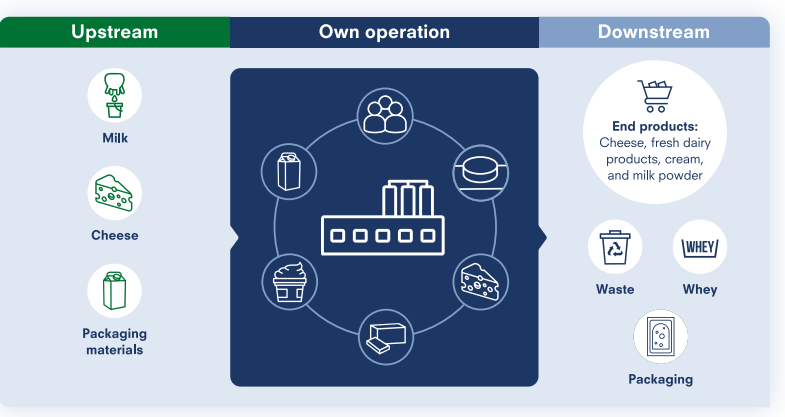
Packaging as a substantive material inflow is discussed in the Packaging paraghraph.
Objectives and actions
We aim to minimise food waste from both an environmental and an economic perspective. To effectively monitor and manage our progress, we express food waste as a percentage of total sales. We use this metric to assess the effectiveness of our interventions, which include addressing the root causes of avoidable waste and improving production processes.
Actions
To minimise food waste, we ongoing take the following actions:
-
Improving processes to minimise production losses, reducing the volume of waste. Facilities establish their own action plans and timelines to achieve our food waste target, starting with efficiency improvements before implementing more complex reuse measures.
-
Maximising the use of side streams to make new products. Leftover cheese is repurposed into products such as grated and melted cheese. Whey, a side stream of cheese production, is sent to a partner to be processed into ingredients for baby food, sports nutrition and animal feed.
-
Adjusting recipes to reduce the use of raw materials.
-
Pursue the certification of our facilities in accordance with industry standards such as FSSC 22000. All sites participate in the FSSC 22000 certification process to control product loss, ensure compliance with quality and safety standards, and develop strategies to reduce food waste.
Planned actions
We plan to implement the following actions:
-
Exploring actions to further minimise food waste.
-
Implement environmental management systems for all our facilities in accordance with the ISO 14001 standard.
Targets and achievements
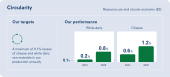
Royal A-ware has defined a clear target to manage the impact and opportunity associated with circularity. The target focuses on limiting food waste to a maximum of 0,1%, this minimisation of waste directly reduces the demand for milk as a raw materials. By doing so, it helps to slow down the depletion of resources and supports their sustainable management and long-term availability of milk.
Resource inflows
The percentage of biological materials that is sustainably sourced, specifically milk, shows a substantial increase from 23 to 37 percent. This is due to an increasing demand from customers for our sustainable milk streams which focus on relevant sustainability KPI’s.
Circularity in dairy production expressed in losses
The percentages for 2025 show an increase in losses for as well white dairy as cheese. The increase in cheese relates to a different classification of organic waste used in 2025 compared with 2024. The increase in white dairy is mainly due to the acquisition of more white diary production locations.
Other information
|
2025 |
2024 |
|||||
|---|---|---|---|---|---|---|
|
Resource inflows |
Milk |
Cheese |
Total |
Milk |
Cheese |
Total |
|
Total weight (tonnes) |
2,541,928 |
192,426 |
2,734,354 |
2,173,653 |
194,994 |
2,368,647 |
|
% of biological materials that is sustainably sourced |
37% |
2% |
23% |
2% |
||
